Deeply Resentful
What Google's employee number four tells us about parental leave
Also published on Substack .
I thought I was going to take a break from writing this week, but then a threads post caught my attention, and I just couldn’t let it go. You might say that as someone who has spent a lot of time researching the history of tech company language and benefits, I became a little bit obsessed with this tiny slice of Google lore.
Heather Cairns was the fourth employee at Google, and worked as the head of HR from 1998 to their IPO in 2005. She is promoting a soon-to-be-released memoir called “Employee Number Four”, and she posted here what I assume is an excerpt that describes the first woman to take maternity leave.
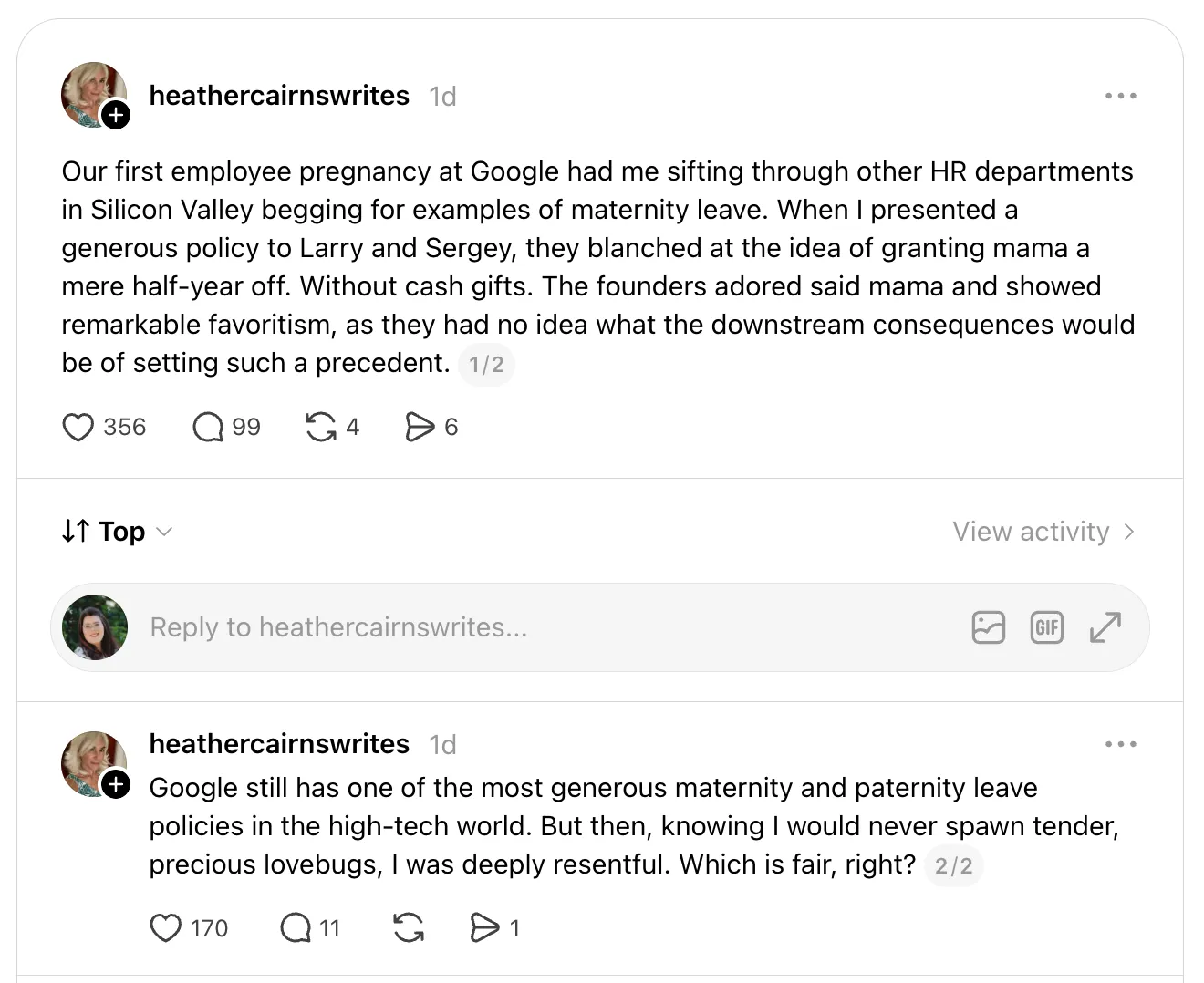
In short, here’s the story she tells.
- When the first pregnant woman needed to take a maternity leave at Google, Cairns asked around at other companies to find out what kind of leave they should offer.
- She came back to Larry Page and Sergey Brin, and proposed a (very generous for the time), six-month, paid maternity leave.
- They were taken aback, and thought that this “mama” should receive more time off AND cash gifts.
- Cairns can’t believe that they are showing this much favoritism to this woman. She alludes that they might be setting a bad precedent, and that this policy is unfair to her, as a woman who doesn’t plan to have “tender, precious lovebugs” of her own.
Classy, right? It’s definitely a bold move to admit that you were an HR professional who saw another employee’s maternity leave as a glorified vacation, and felt resentful because your own childbearing plans meant that you can’t have one too.
But other than the obvious bad taste (or possible rage bait) of this post, something else just kept bugging me. Given everything I know about Google during this era, some of the facts of this story just don’t add up.
Of course, as a rando on the internet who has never worked at Google, I obviously don’t have first-hand knowledge here. But in order to judge this account’s accuracy, I can compare it with the account of the other person who was there—the unnamed “mama” whom Larry and Sergey supposedly showed so much favoritism towards. This woman was almost certainly Susan Wojcicki.
Susan Wojcicki first became involved with the Google founders as their landlord. She rented out her garage to Larry Page and Sergey Brin so they could start their search engine. In 1999, she joined Google as their first marketing manager (while she was four months pregnant). She later went on to become the CEO of YouTube, and before her death in 2024, she went on the record multiple times talking about her experience as the first woman at Google to take maternity leave.
Here’s the account she gave at Fortune’s Most Powerful Women Summit, quoted by CNN Money in 2016.
“When I first started I don’t think we really had an HR department. So it wasn’t really clear,” she said. “Hey Larry, hey Sergey, I’m going to take a little time off … Nobody had ever done it before at the company.”
She doesn’t say exactly how much time she took for her first maternity leave, so it’s entirely possible that Larry and Sergey offered her more than half a year plus cash gifts that Cairns alludes to in her story. But the formal record tells a different story.
As I have talked about in previous posts, I’m doing a research project called The Language of Work where I am using AI-generated embeddings to track company careers page copy over time. The first formal reference to maternity leave that I could find in my corpus is from 2003. At the time, Google offered birth parents 12 weeks of leave at 75% pay, and their partners 2 weeks at 100% pay. In 2008, this was increased to 18 weeks for birth parents and 12 weeks for partners. Wojcicki confirms this timeline in her 2018 OpEd for the Wall Street Journal. She argues for the importance of maternity leave, and claims that when the default maternity leave was raised to 18 weeks from 12, attrition of new mothers at Google fell by 50%. This is an internal measurement that I can’t confirm, but it certainly sounds plausible.
So what likely happened? Wojcicki probably took somewhere in the ballpark of what Google formally offered—not over six months, but a more modest stretch of time that she had to negotiate ad hoc because no policy existed. Cairns either misremembered the conversation, or she has remembered it through the lens of her own resentment. Either way, the gap between her account and the record is telling.
Why this matters goes beyond one memoir’s credibility. Cairns’s resentment, and the idea that parental leave is unearned favoritism that non-parents subsidize with extra work, is not an outlier. I suspect that this attitude has played an important role in how parental leave is viewed, both within private companies and the larger political sphere.
As the only developed country that doesn’t offer parents any legally protected parental leave, parental leave has always been a sensitive subject in the US. Parents who have cobbled together childcare so they can go back to work weeks after giving birth, or given up good-paying jobs because they couldn’t take time off, or experienced any number of the downstream effects of this policy can attest to the importance of paid leave.

Photo by Ana Curcan on Unsplash
Some states (like Washington, where I live) provide some state-funded parental leave. But for most of the US, the only way to get paid parental leave is to work at a private company that offers it as an employee benefit. For many workers, this just isn’t a thing, and people who work for big companies like Google that provide any amount of paid leave are considered very lucky.
Author's note
Even when I worked with public school teachers who had a union-negotiated contract, women would save up their sick time or try to plan their pregnancies so they could give birth in the summer in order to get time off above and beyond the legally-mandated, unpaid 6 weeks of FMLA.
This privatization of parental leave breeds exactly the kind of resentment that Cairns expresses. In 2000, Elinor Burkett published The Baby Boon: How Family-Friendly America Cheats the Childless, framing family benefits as a massive redistribution of wealth from non-parents to parents. And as quoted in a NYT Magazine review: “The company is making it possible for parents to have their child and their Lexus, too, by loading the financial and logistical burdens of parenthood onto the backs of the childless.”
While most workers who express similar sentiments aren’t saying it out loud to this extreme, this zero-sum mentality that parental leave is only possible because non-parents pay for it and do the extra work is still common today. The companies that offer it frame it as a perk (which makes them sound generous) rather than as support for a human necessity (which might suggest it should be universal). And that framing has real consequences.
Author's note
I don’t feel like digging up specific citations, but this s*** is all over forums like Reddit and Blind.
Today, Google offers birth parents and partners 24 and 18 weeks of fully-paid time off, respectively. This is genuinely generous by American standards. But I keep thinking about all those closed-door conversations on the way to that number—the justifications parents had to make to non-parents who saw it as favoritism, the endless trade-offs, the way even the most progressive tech company’s maternity leave had to be extracted from resentful HR managers. That’s the real story. And it suggests that as long as we’re leaving this to the private sector, and as long as resentment frames the conversation, we’ll never get anywhere close to what working parents actually need.