Right on Time
What 3,130 knitting designers taught me about breaking into the creator economy
Also published on Substack .
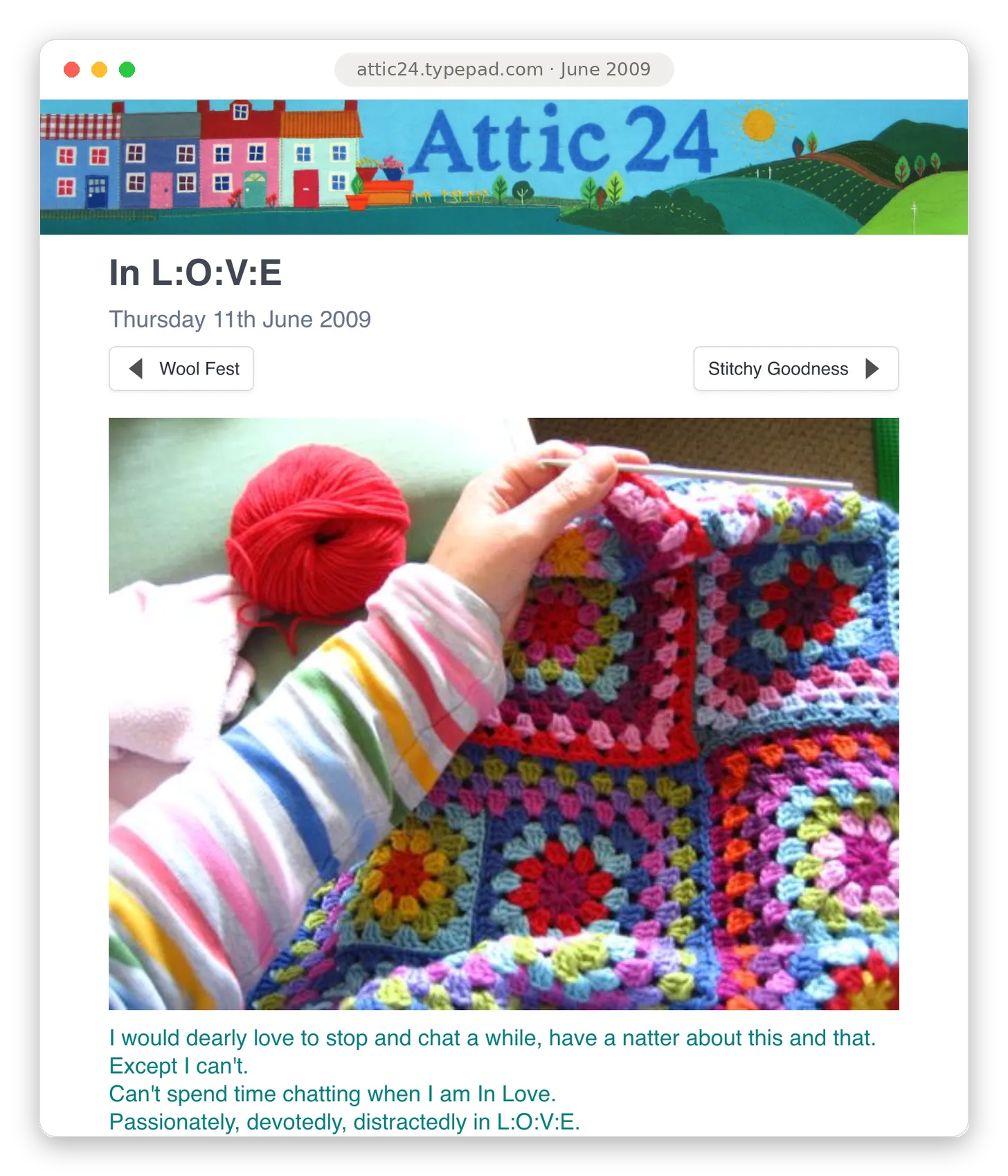
In March 2008, a woman named Lucy started a blog from her home in Yorkshire. She started out documenting her domestic life in a small town, but pretty quickly began photographing her colorful crochet projects, having learned to crochet a year earlier. She wrote in her first post:
For a while now I have thought about beginning my own blog. I think I might’ve been a little late to arrive at the Blog Party having only stumbled across them in the summer of 2007. Up until then I had no idea this amazing community existed, had no idea that there might be other creative, domesticated so-and-so’s out there who get excited about crochet, stitching, baking, flowers, corners of rooms.
She thought she might be late to the blog party, but the record shows that she was right on time. Her cozy blog full of colorful mugs of tea and crocheted blankets became one of the most influential and recognizable crafting blogs of the era, and her free crochet patterns still show up as some of the most popular crochet patterns on Ravelry, the online community for fiber artists that started the same year.
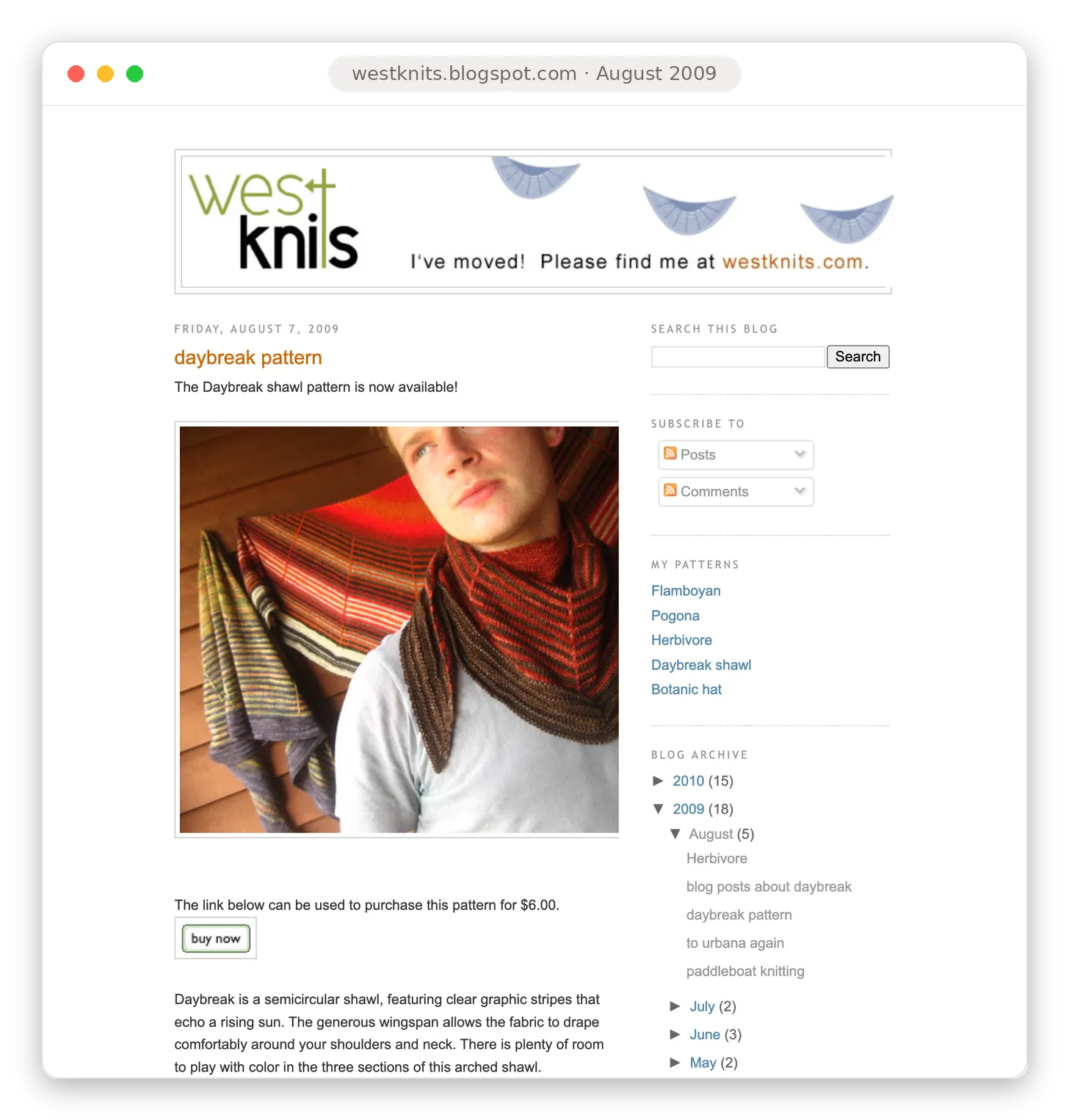
In August 2009, Stephen West was working in a yarn shop in Urbana, IL while studying dance at the University of Illinois. He had been sporadically posting about his knitting projects on Blogger, and a few people were starting to follow along. When he published his first knitting pattern, the Daybreak Shawl, other bloggers took notice and started writing about it, and it shot to the top of the charts on Ravelry. He followed it up with a couple more shawl designs, and by April 2010 he was on an east coast tour, teaching workshops at several well-known yarn shops. In August 2010, just a year after his first pattern release, he was finishing the draft of his first book and moving to Amsterdam to start Westknits, his knitting design business.
In December 2016, Andrea Mowry published a shawl pattern that became an immediate sensation. The Find Your Fade shawl showed up at the top of everyone’s feeds, and kicked off a hand-dyed, technicolor craze that lasted for the next couple of years. A 2019 profile in The Cut says she “rocketed to the top from out of almost nowhere” after publishing her first pattern in August 2014. But during those two years, she had been participating in knit-a-longs, posting daily Instagram posts about her work, networking with designers and yarn companies (including Stephen West), and releasing 2-3 new patterns each month that she personally tested, modeled, and marketed. She was the designer for the Instagram era—polished, colorful, and conventionally attractive—and she amassed a fan base that returned to her patterns over and over again.
And then there’s the reigning champion of Ravelry, who arrived on the scene in 2016 with timeless neutrals, clean lines, and a signature effortless Scandinavian aesthetic. Mette Wendelboe Okkels, known by her brand name PetiteKnit, started publishing knitting patterns while on (state-subsidized, year-long) maternity leave in Denmark in 2016, and has continued to release at least three new patterns per month ever since and post about them for her 1.5 million followers on Instagram.
Every one of these designers is undeniably good at what they do, but they have something in common beyond skill. Each of them started publishing during a specific window of opportunity. Lucy and Stephen started in the Google Reader era, when distribution was less mediated by algorithms and discovery happened through other bloggers and search engines; an amateur could buy a digital camera, post photos of their projects, and find an audience that kept coming back. Andrea and Mette were products of the early-algorithm Instagram era, where aspirational looks, curated flat-lays, and the right hashtags could go a long way, as long as you were churning out new content for the feed every single day.
But something I think many of us feel, but struggle to measure, is that these windows have been closing. It is harder to break into a crowded platform and get your work in front of the right people, and the pressure to do so has never been higher. As traditional media outlets collapse and stable employment feels less guaranteed, many of us are turning to the creator economy as a source of income and professional opportunity.
In order to better understand this phenomenon, I have tracked 3,130 knitting designers on Ravelry across twenty years, and I am piecing together the story of what it took to be successful in each era. Spoiler alert: if it seems harder to make it as an online creator today, it’s because it is.
Why knitting, of all things
I have been knitting for most of my life. My grandmother was raised on a sheep farm in Northern Ireland, and knit Aran sweaters as a teenager to make a little bit of money. When I was nine or ten, I got bored staying at her house one afternoon, so she went into her mudroom closet and pulled out a box of knitting needles and a ball of bright green wool. She taught me how to cast on and started my row of knit stitches, and I was hooked. The very first thing I made was a very wonky rectangle, but I was proud of it.
For a while, I just made bigger rectangles out of colorful skeins of Red Heart acrylic yarn I bought with my allowance at Hobby Lobby. But sooner or later, I wanted to learn how to make other things too. Fortunately, I had just learned about this new thing called the internet where I could learn about knitting and see other people’s knitting projects.
So, as a millennial who has been following the online fiber arts community since the late 90’s, here is why I think Ravelry can teach us something about the creator economy that is hard to measure anywhere else. The way we share and discover information on the internet has changed so much in a relatively short period of time. We have now moved from a world where we have to actively seek out the content we want to see to a world where large companies track us to figure out what content they think we want to see, and then serve it to us.
But amidst all this change, Ravelry, the online fiber arts community that was started by a husband and wife in 2007, has remained largely unchanged. (The underlying mechanism, that is. The design famously changed once, in 2020, and created such a stir that the fallout was covered in The New Yorker.) To this day, there is still no news feed, no algorithm, no mysterious AI bot telling me what to knit next, and despite some of the controversies over the years, it is still the primary place to buy and sell knitting patterns online.
So when we see changes in who is popular or how quickly that popularity grows, we are presumably not seeing changes inside Ravelry, but rather we are seeing changes in how designers promote themselves on other platforms, and how successful they are.
Different results for different cohorts
In order to build my dataset, I built a Python script that randomly sampled pattern IDs and traced them back to the designers who created them. I ended up with a set of 3,130 knitting designers, and the dataset naturally includes most of the current well-known knitting designers, since the sheer number of patterns they have published gives them a high probability of being randomly selected.
I broke down this set of designers by entry cohort, grouping them by the year their first pattern was published on Ravelry. About a quarter of the designers turned out to have catalogs that live mostly in books and magazines—print-era designers whose back catalogs were imported into Ravelry’s database after their original publication. Many of them came from an era where you could just… get a regular job testing and writing patterns for yarn companies, which seems almost incomprehensible today. They are in my dataset, but for the sake of comparison, I’m looking largely at internet-era designers.
Among these designers, three distinct groups emerge: the blog era entrants, the Instagram early algorithm entrants, and everyone else who started publishing after about 2017.
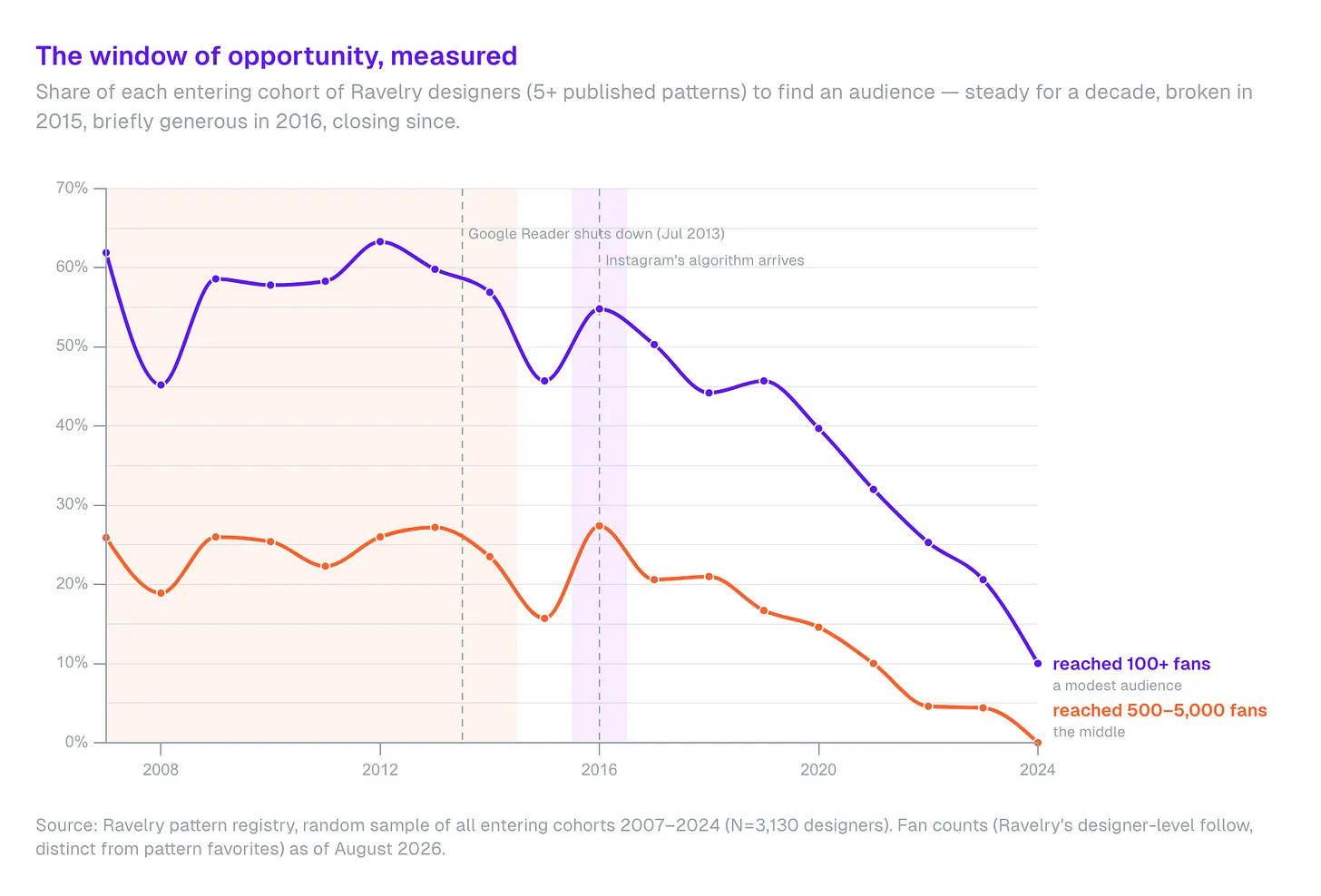
According to my dataset, a designer who started between 2007 and 2014 who published at least five patterns had about a 60% chance of reaching 100 fans—that is, 100 knitters who favorited the designer, not just one of their patterns—which is my definition of a modest audience. They also had a roughly 25% chance of reaching 500-5000 fans. I defined this 500-5000 group as the “middle band,” meaning maybe they aren’t wildly successful, but they are probably making at least a side income off of their paid patterns. Note that fan counts are a measurement of attention, not a measurement of sales on Ravelry or any other platform, but it’s the best approximation I can get from publicly available data.
After 2014, there was a dip that seems to roughly coincide with the retirement of Google Reader, followed by a bump that lines up with the first year the Instagram discovery algorithm was introduced. After that, we can see a steady decline, ending in 2024 when a new pattern designer has only a 10% chance of reaching over 100 fans, and no chance—literally zero designers in my sample—of getting over 500. (To be fair, the top performer of 2024 did get close, with 471 fans.)
How much is just time?
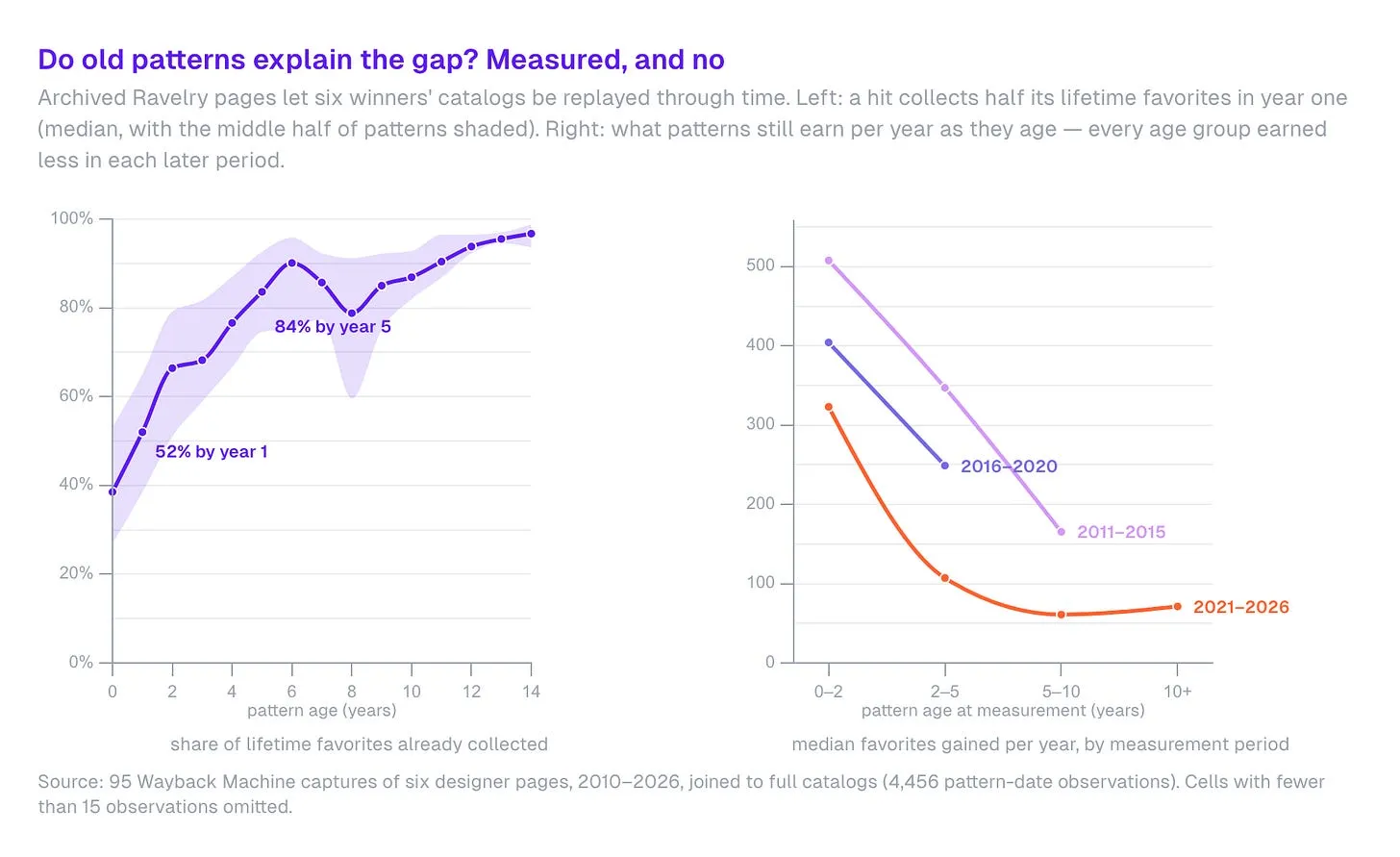
Do some designers get more engagement just because they have had more time to grow? I also did a little bit of due diligence to make sure this isn’t just a result of older patterns having more time on the platform. I pulled historic snapshots of six of the most successful designers’ catalogs from the Wayback Machine, and they show that a hit pattern gets around 52% of its lifetime favorites in the first year after release, and 84% in the first five years. Careers reveal themselves fast, and a back catalog is a smaller advantage than it looks. And as you can see in the visualization below, even the winners’ brand-new patterns earn fewer favorites per year in the 2020s than their new patterns did in the 2010s.
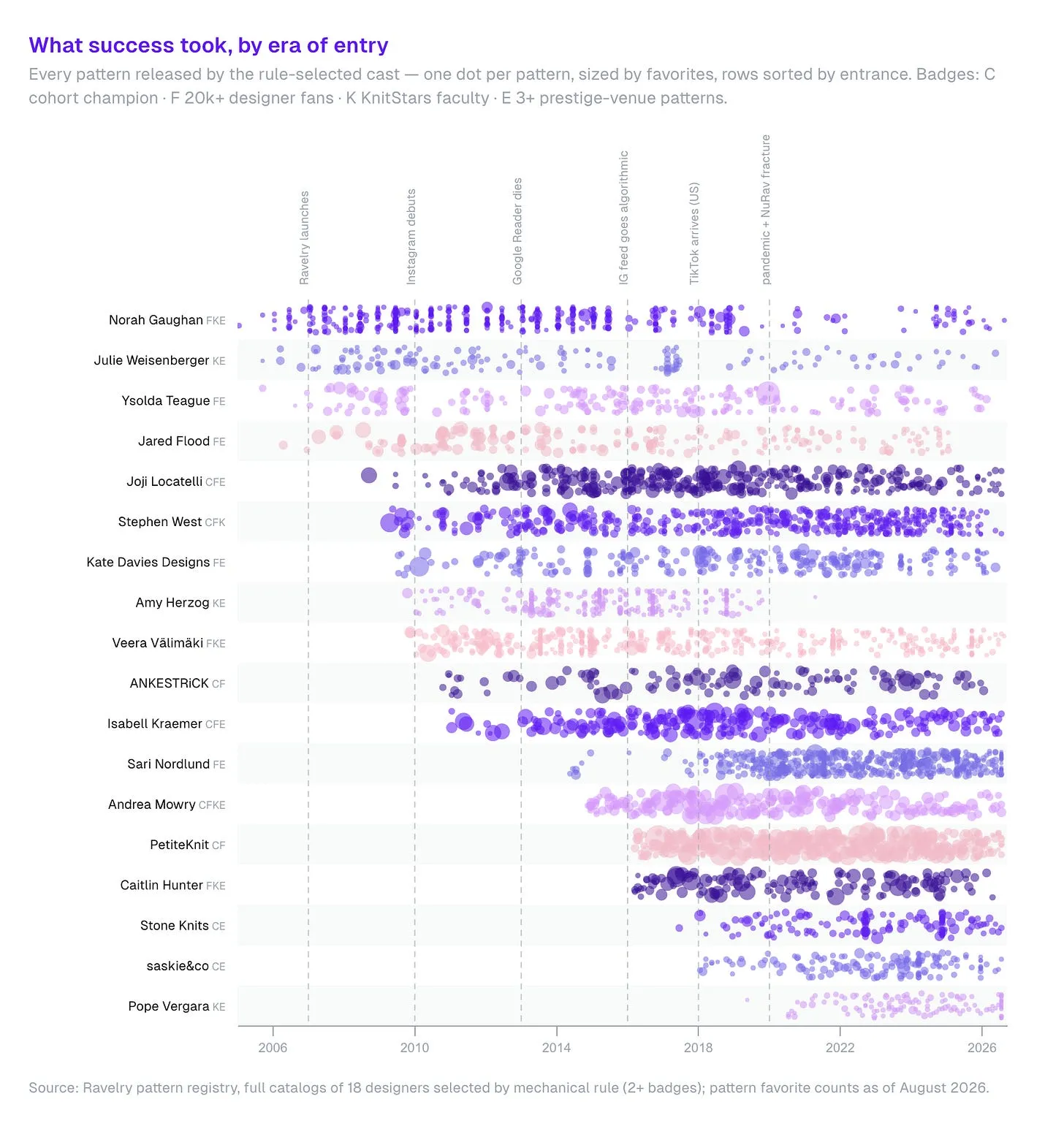
Here’s another view of this that I find fascinating. When you look at the frequency that patterns are released for this curated set of designers, you can see the sheer amount of work that goes into being successful on Ravelry. A few of these designers, particularly the blog-era entrants, tested the waters with one or two patterns before committing to the work full-time, but designers like Andrea Mowry and PetiteKnit were releasing 2 or more patterns per month right out of the gate. And we can also clearly see how later entrants like saskie&co and Pope Vergara are getting fewer favorites for a similar number of patterns.
Is Ravelry just dying?
I do have one more question that could affect the validity of this data, which is—what if fewer people are using Ravelry now? People might still use Ravelry for actually purchasing patterns and saving them in their library, but are they still interacting with them in a way that shows up in this data, or has that moved to other platforms? Here’s what I do know: project counts (the number of items made with this pattern and logged on the platform) have stayed consistent over time—right around 2.2 million new projects logged every year since 2011—while new patterns added per year climbed from the 50-60 thousands in Ravelry’s early years to a 2020 peak of about 109,000, and still run above 90,000. The supply of patterns roughly doubled while the pool of attention stayed the same size.
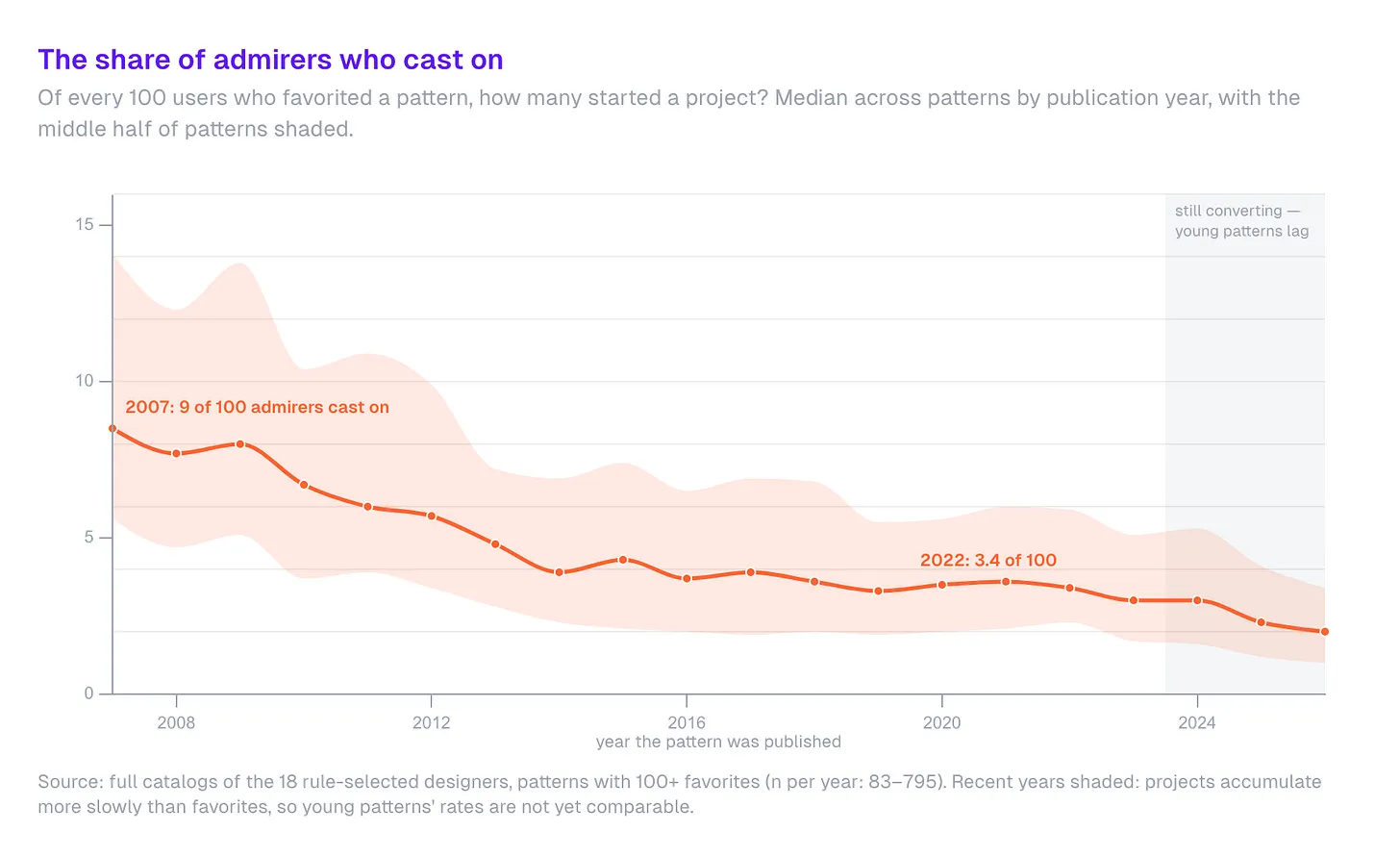
And when we compare the number of favorites to the number of projects to get a rough “conversion rate” of how many admirers actually cast on, that rate has declined too—even for patterns old enough to have finished accumulating projects—meaning designers now collect more favorites per project than they used to. It seems like users are still engaging with patterns on Ravelry, but that engagement is getting more diffuse and more passive: a similar amount of knitting is spread across many more patterns, and a favorite means less commitment than it once did.
And designers still have a huge incentive to get attention on Ravelry and direct their audience there. Showing up on the most popular or “hot right now” lists makes your pattern discoverable, and makes knitters more likely to trust you enough to spend 40+ hours of their life and $200 in yarn knitting your sweater. In ten years, I have never met a knitter who doesn’t regularly use Ravelry, or can’t name the current top patterns by name. “Oh, you’re making a Step by Step sweater? Nice! I’m making a Sophie Scarf.”
The part that isn’t about knitting
So, I just threw a lot of data at you, but what does it all mean? Well, here’s what it means to me. If you are a new creator who is just starting out trying to build a brand, it is actually harder to build an audience, and it is harder to convert that audience into a meaningful income stream. As platforms like Substack become more populated with celebrities, well-known journalists, or bloggers who got their start on other platforms, there is a smaller slice of attention that goes to new creators, even if the overall engagement keeps going up. Because it turns out that when you started matters just as much as the quality or quantity of your work. I suspect that these windows of opportunity that I saw in the Ravelry data aren’t just for knitting designers—they reflect the experience of nearly everyone who feels crazy trying to trick an ever-increasing number of black-box algorithms into showing people their work.
There’s so much more I could say about this, and I might have some follow-up posts where I go deeper into the rabbit hole. But for now, it’s good to know that it’s not just me.