Dark Places
David Heinemeier Hansson, 37signals, and the myth of the non-political workplace
Also published on Substack .
Content note: this post quotes anti-migrant, anti-Roma, and anti-trans rhetoric verbatim, including dehumanizing language and a slur for Roma people. The quotes are the evidence, so I’ve kept them exact rather than paraphrasing.
In my last post, I attempted to measure “masculine energy”. I scored my whole corpus of company careers page text on a gender axis and ranked which companies lean the hardest on masculine-coded language. But here’s the question I couldn’t stop thinking about: why does this matter? Sure, the performative toughness rubs me the wrong way sometimes, but even I, the woman with a whole shelf full of feminist writers, have to admit that masculinity in and of itself isn’t a bad thing. Building, moving decisively, and communicating clearly are usually good things to do at work regardless of your gender identity.
In that post, I made a note of a company that seemed to be a bit of an outlier, and it has been bugging me ever since. So I did some more research.
37signals is small, but influential in the tech industry. (The company went by Basecamp from 2014 to 2022, after its flagship product, which is why all the contemporaneous coverage of what follows says Basecamp.) Co-founder and CTO David Heinemeier Hansson (often referred to just as DHH) was the creator of Ruby on Rails, a widely used framework for building web applications. Both Hansson and co-founder Jason Fried have published books on their workplace culture, and clearly consider themselves to be a model for the entire industry.
Particularly in Chicago (where I’m from), Basecamp was always considered one of the best places to work, which is why the company’s trajectory in 2021 surprised me. For those of you who are not chronically online tech workers, let me summarize.
The rupture
In early 2021, Basecamp employees launched a DEI initiative. Employees were particularly concerned about a list of “funny” customer names that had circulated internally for over a decade, and about a third of the company’s 57 employees volunteered to join the initiative and discuss issues like this one. Two employees did a write-up on the list of names that referenced the Anti-Defamation League’s “Pyramid of Hate” concept, which argues that poking fun at people from different cultures and ethnicities may not be immediately harmful, but it can lay the groundwork for hate speech, discrimination, or worse.
Hansson’s response, as reported in detail by The Verge, acknowledged that management had failed to act on the list for years, but also objected to the Pyramid of Hate as catastrophizing. He dug up old chat logs to show that one of the complaining employees had once participated in the list themselves.
Rather than listening to employees’ concerns and continuing to work to resolve this tension internally, Fried and Hansson decided to roll out a public-facing policy change that became a primary topic of conversation in the tech world for weeks. In April 2021, Jason Fried published a blog post entitled “Changes at Basecamp” that said:
“No more societal and political discussions on our company Basecamp account. […] It’s become too much. It’s a major distraction. It saps our energy, and redirects our dialog towards dark places.”
They also disbanded the DEI committee, cut “paternalistic” benefits, and offered a buyout for anyone who disagreed. Around 20 of the company’s 57 employees took it — including the head of design, the head of marketing, the head of customer support, and most of the iOS team. At the final all-hands, Ryan Singer, the head of strategy and an eighteen-year veteran, was suspended after disputing whether “white supremacy” belonged in a conversation about the company’s culture, and then resigned. Casey Newton at Platformer has the fullest account.
So in other words, employees brought up concerns about racial stereotypes inside Basecamp, and rather than listen, engage, and revise internal practices, the founders shut down the conversation by publicly airing their issues and banning political conversations at work.
The outlier
Basecamp/37signals has shown up as an outlier in my research a couple of times now. Despite the size of the company, the founders have—to put it lightly—a lot of opinions. So they have given me one of the largest corpora in my dataset, the fifth-largest of over twenty companies. Despite the sheer amount of writing they have done about their company culture, their technical practices, and how they set themselves apart from the rest of the tech industry, they have been largely silent on the topic of diversity and inclusion. Only four percent of the text I analyzed mentions it, as opposed to 26-52% for the other four companies of comparable corpus size. Only Coinbase and Palantir scored lower, and that was true even before Basecamp disbanded the DEI committee in 2021.
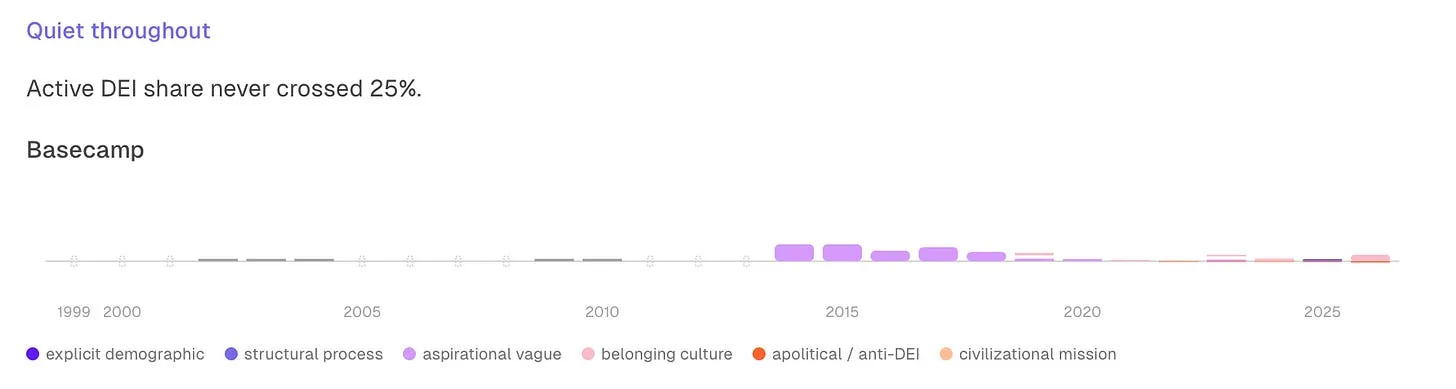
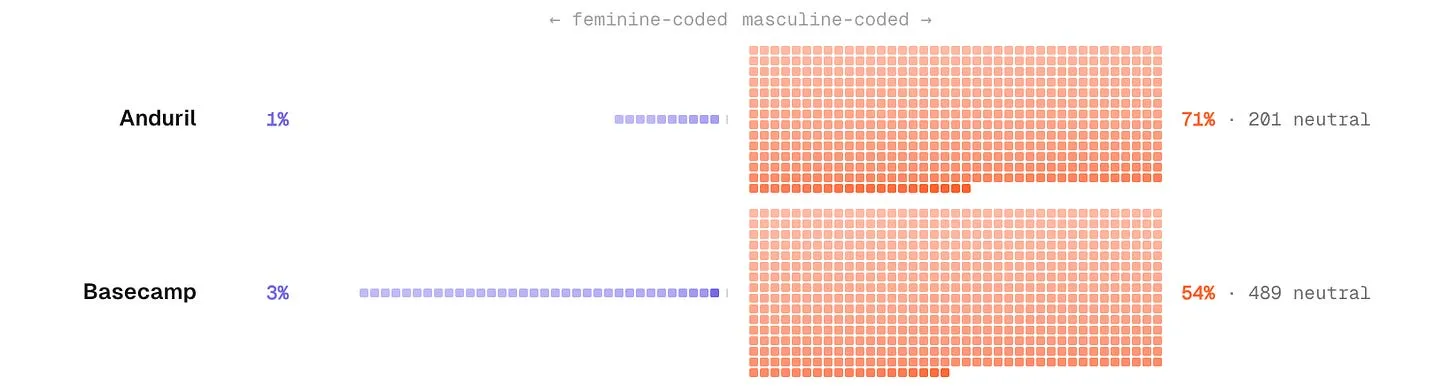
They also rank second, next to Anduril (a literal weapons manufacturer) as the most masculine-coded company in my corpus, ahead of SpaceX and Palantir. Most likely this is because so much of the cultural canon was written by the founders themselves and not by recruiters or HR teams.
The “non-political workplace”
Jason Fried’s 2021 memo stated that they were concerned about their dialog going to “dark places”, but I don’t think they were aware yet of the irony of this statement. As a part of my research for this story, I scraped all 512 posts from Hansson’s 37signals-hosted blog. Just in the last 8 weeks, Hansson has brought us some gems such as: “The Rape of Britain.” “Three sacred cows that must die so Europe can live.” “European Delusions & Danish Drones.” “Wolves, sheep, and gypsies.” That last one, captured on July 21, builds an extended analogy between Denmark’s wolf population and Roma people in Copenhagen, and ends:
“When wolves get out of control, you shoot them. When gypsies take over public spaces, you deport them. This isn’t hard, it isn’t cruel. It’s the basic logic of self-preservation.”
So much for the “non-political workplace”. Using his company’s platform to say that Roma people should be deported from the places they have lived for centuries is a discussion about cultural groups and government affairs — which is the definition of political speech.
I should note at this point that the rules about political speech at 37signals have never explicitly included the founders’ blog posts. But in this two-tiered system, they have created a dynamic where the company leaders are allowed to disparage marginalized groups in public, and their employees aren’t allowed to say anything about it in the group chat.
The shift
In order to better understand what happened after 2021, I ran an instrument over every post to extract references to marginalized groups. This surfaced references to Roma, Muslims, trans people, and other groups. It also codes the tone of the reference—is it a neutral call-out, general hostility, or does it frame these groups as a threat?
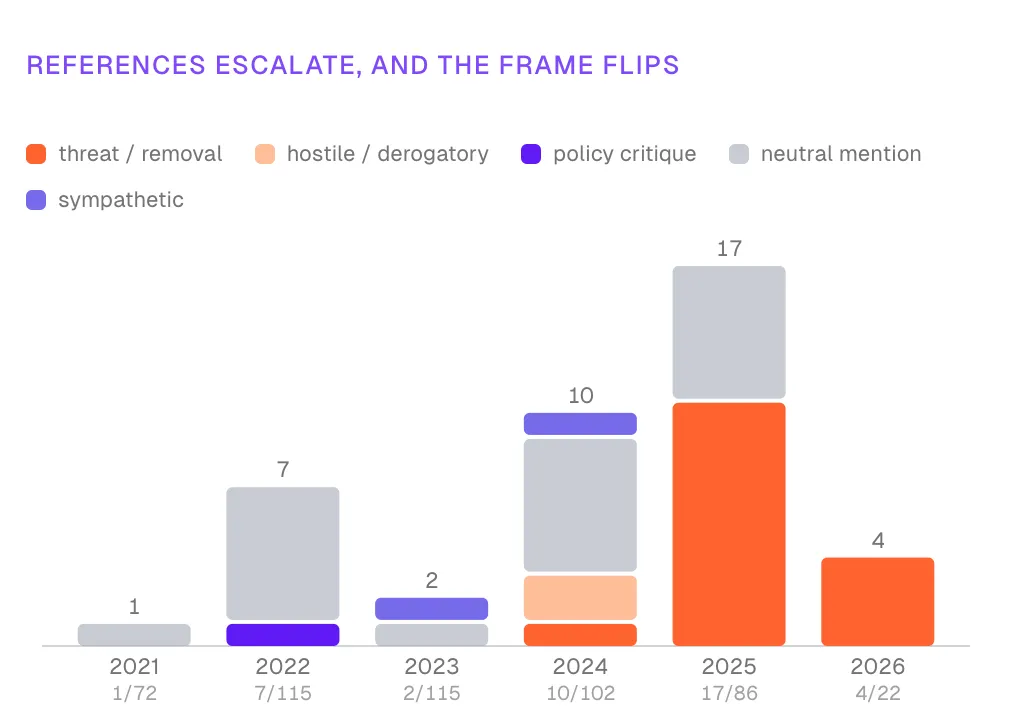
In 2021, only one post references a marginalized group. In 2022 and 2023, a handful do, but none frame a group as a threat. In 2024, he starts citing statistics (with an unclear source) about migrants and crime rates in Denmark.
They went with an open-door policy on immigration for far longer, ended up taking many more (about 3x Denmark), and are now in a world of hurt with the highest gun-murder rate in all of Europe, along with an overall crime rate 50% greater than Denmark.
2024 is also when the blog starts in on trans people — first as punchlines, then as a threat to what one post title calls “The endangered state of normality.” By February 2025 he’s writing about “the trans mania” and “men who said they were women”; by June, a post about his children’s school in Copenhagen describes a gender-ideology “obsession” that has “ravaged many schools in America” and calls a student gender-and-sexuality club “overt indoctrination.”
In 2025, seventeen posts reference marginalized groups—nine of them are about migrants or refugees, and eleven of the seventeen reference crime or call for their removal. And in 2026 so far, all four referencing posts are threat-framed, and Roma appear for the first time. A July post endorses “remigration” by name: “millions who are already in Europe must go.” That word has a specific home in European identitarian politics, and it’s a favorite topic of the online far-right.
His references to migrants have increased even as his blogging cadence has slowed, so the share of his posts about marginalized people has risen from both directions at once. His writing went from slightly self-righteous tech founder to overtly hostile to marginalized groups in about thirty months—this is radicalization happening in real-time.
The network
Two of the names in this timeline may need an introduction. Tobias Lütke is the co-founder and CEO of Shopify, the Canadian e-commerce company whose software runs millions of online stores. Before he was a CEO he was a Rails programmer: in 2004 he built Snowdevil, the online snowboard shop that became Shopify, on a pre-release version of Rails, and he served on the framework’s early core team. He and Hansson have been in each other’s professional orbit for as long as Rails has existed. Brian Armstrong is the co-founder and CEO of Coinbase, the largest cryptocurrency exchange in the US.
February 2017. Tobias Lütke publishes an open letter refusing demands that Shopify drop Breitbart’s online store, framing the refusal as a free-speech principle. This is the earliest “we don’t do politics, we do commerce” document in my whole dataset — three and a half years before anyone else in the cohort.
September 2020. Brian Armstrong publishes “Coinbase is a mission focused company,” barring societal and political debate at work. Employees who disagree are offered severance.
April 2021. Fried and Hansson follow with “Changes at Basecamp,” seven months later, with the same structure: no politics where the work happens, exit packages for dissenters.
January 31, 2022. Lütke joins Coinbase’s board. The stated rationale is crypto and commerce: Lütke calls it a “like-minded vision” of Web3 and entrepreneurship.
November 19, 2024. Hansson joins Shopify’s board. Twenty years after Snowdevil, Hansson titled his own announcement “20 years in the making.”
September 2025. An open letter (Plan Vert) asks Ruby and Rails institutions to cut ties with Hansson over what it calls his “racist and transphobic views.” Lütke publicly dismisses it. David Celis, a longtime Rails contributor, documents the escalation and calls for new Rails governance.
July 2026. The same month Hansson publishes the wolves post, Lütke replies “Good system” to a proposal giving five votes to people paying $500k+ in taxes and zero votes to people paying none, then adds that pensioners are dependents and “that means no voting”.
The syllabus
As for where Hansson got these ideas, we don’t have to wonder. He told the story himself last week on David Senra’s Founders podcast (episode posted July 26, 2026), summarized in this X post of the key clip. In his telling: after the 2021 exodus, with tens of thousands of people criticizing him on Twitter, it was Tobi Lütke who put him in contact with Marc Andreessen — Andreessen had seen the same “phenomenon” at his portfolio companies. Andreessen offered reassurance, contacts, and operational help, and urged him not to apologize or revert.
And then, in Hansson’s words, Andreessen “gave me a syllabus for understanding the history of wokeness” — the Frankfurt School, Herbert Marcuse, a decades-long plot against Western institutions. By the end of the clip, Hansson is describing his employees’ DEI concerns as part of a civilizational battle against “the white walkers beyond the wall.”
Author's note
I would like to thank the author of this reddit post for pointing to the Hansson/Andreessen connection and helping me to piece together the timeline.
The fascism of it all
It’s clear that 37signals, like a large portion of the tech industry, has a bit of a fascism problem right now. Hansson isn’t the first tech founder to face pushback and then court white supremacy and far-right extremism; it’s a known pattern. But why does it feel so important to me specifically?
Well, I think it means that my pattern-matching is working. Masculine-coded language on your careers page could be neutral, or it could be a signal of a lack of consideration for different groups who could be reading it. Political neutrality could be a genuine call for workplace professionalism, or it could be a way of silencing employees who are raising concerns. When I see these two signals together, it often means there is more extremism lurking beneath the surface.
Ironically, the framework that describes this the best is the one that triggered Hansson’s far-right swing: The Pyramid of Hate. Subtle biases that are allowed to propagate lay the groundwork for more extreme speech, discrimination, and violence. Hansson was given an opportunity to grapple with this. But rather than acknowledging the pyramid, he decided to ascend it.

Photo by Colin Lloyd on Unsplash